
My current research projects leverage multimodal MRI data to understand the effects neighborhood factors on neural processing of threat, reward, and inhibitory control.
For example, we demonstrated that greater neighborhood disadvantage is associated with differential reactivity to threat but not reward. Moreover, the effect of neighborhood disadvantage on threat reactivity is mediated by underlying changes to white matter microstructure (Webb et al. 2023, JAMA Network Open). Taken together, these data suggest that neighborhood disadvantage, a contextual-level risk factor, changes brain structure which leads to modulation of neural reactivity to threat following trauma exposure.
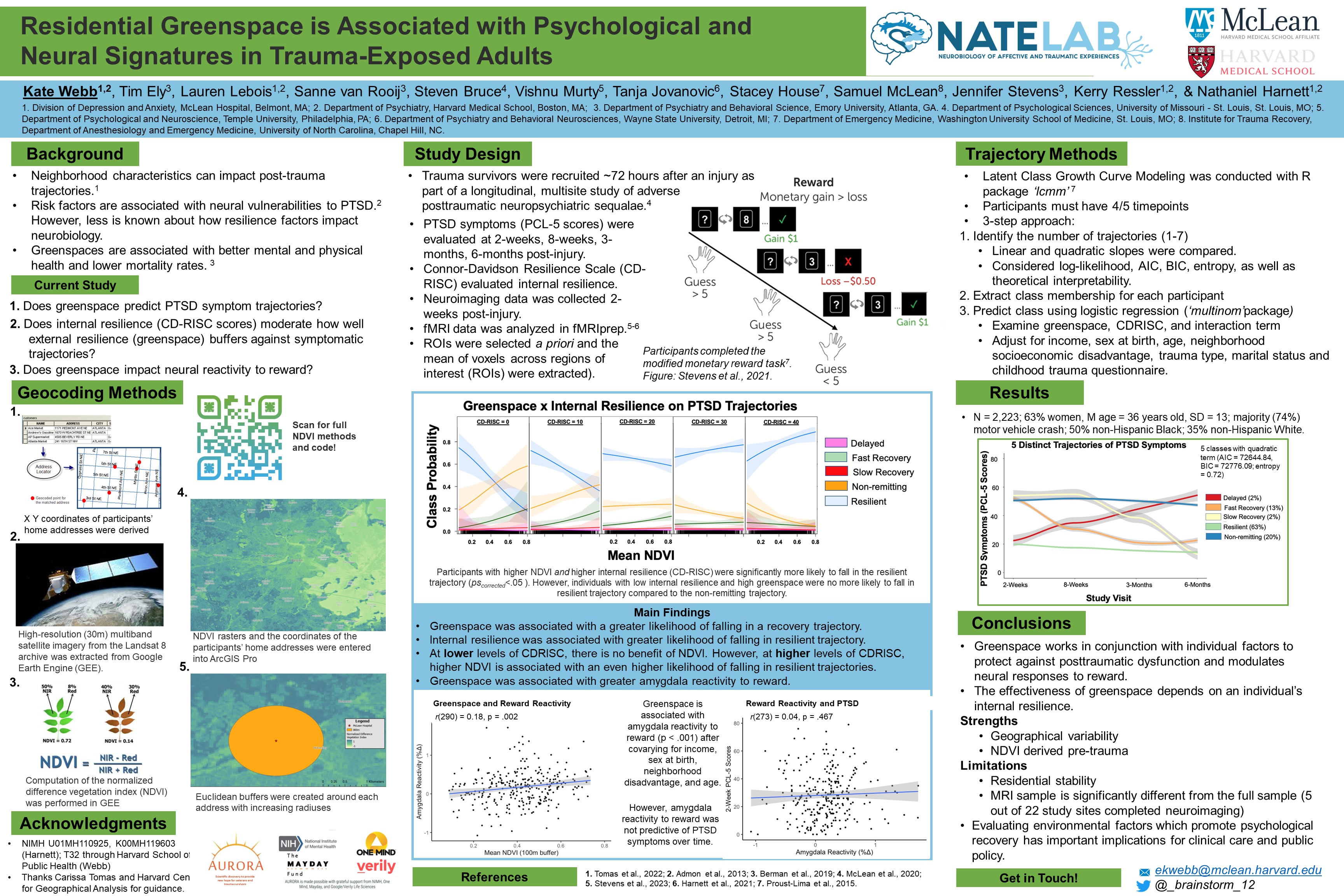
As part of my postdoctoral training, I expanded my skillset to include geospatial analyses to quantify additional neighborhood factors such as greenspace. Our initial results indicate that greater residential greenspace (derived through satellite-imagery) is associated with differential reactivity to reward, but not threat, within the amygdala. Further, we identified a novel interaction between an individual’s internal resilience (i.e., how well they believe they can cope with a problem) and greenspace. Individuals with greater exposure to greenspace and internal resilience show faster recovery following trauma (i.e., rapid decrease in PTSD symptoms across time). Thus, these data further suggest that greenspace modulates neural function following trauma exposure and enhances individual resilience to improve trauma outcomes.
Check out recent posters below!

 ekatewebb.com